
a cudo compute industry report
Land. Power. Compute.
The new limits of AI and where we go from here.
Explore The Report
00 Executive Summary
01 The end of effortless scaling: when infrastructure stopped keeping up
02 The scarcity of viable sites
03 Power is the new pricing layer of AI
04 Thermal management: The hidden infrastructure layer
05 Compute: Scaling AI under constraint
06 The invisible constraint on AI scale
07 The geopolitics of AI
08 Adapting to today’s constraints
09 The physical future of artificial intelligence
10 Appendix
Share
Executive summary
AI infrastructure is no longer constrained only by algorithms or access to GPUs. It is being constrained by land, by the price and availability of power, and by the basic realities of the grid. Increasingly, electricity is what shapes the economics of compute.
For the past three years, much of the industry has behaved as though GPU access is the main determinant of scale. That assumption has underpinned hundreds of billions of dollars of investment. It is now starting to look shaky.
Infrastructure rarely breaks at a single point. It breaks when land, power, cooling, compute and permitting fail to line up in the same place at the same time. That mismatch is already visible across the US, the UK and Europe. Power is not available where it is needed. Grid connections are taking too long. Planning and permitting cannot move fast enough. Cooling systems cannot always handle the densities modern hardware demands. The problem is not any one bottleneck. It is a fact that the whole system has to work together.
That is difficult because each part of the stack moves at a different speed. GPU platforms change on a roughly annual cycle. Grid upgrades, site development and permitting can take years. Even where governments are trying to accelerate delivery, the pace of physical infrastructure still lags behind the pace of hardware development. The gap between where capital is going and what the real world can support is getting wider.
The cost base reflects that shift. Infrastructure is now driving most of the cost in AI deployment, especially power, networking and other energy-related inputs. GPU pricing matters, of course, but often less than expected. At the same time, many organisations remain highly confident in their ability to scale. That confidence looks increasingly out of step with conditions on the ground.
Greater efficiency does not solve this. In many cases, it makes the problem worse. As systems become cheaper or easier to run, they get used more, and total demand rises. The hard limits do not disappear – they remain tied to physical resources that do not scale at anything like software speed.
This is already reshaping where AI gets built. Site selection is becoming less about proximity to end users and more about proximity to available power. Regions with spare grid capacity and developable land are attracting investment, while established hubs are running into congestion, delay and saturation.
In reality, projects rarely unfold in the clean sequence imagined in planning decks. Timelines slip when grid access falls behind. Sites have to be reconsidered when permitting stalls. Backup plans become central plans once external constraints start to bite.
Under those conditions, AI infrastructure is more than a procurement challenge. It is a systems challenge.
The most common mistake is getting the sequence wrong. Hardware is secured before power is locked in. Sites are chosen before grid access is confirmed. Cooling is treated as a later-stage issue, after density assumptions have already been made. By the time the infrastructure constraints are fully understood, many of the decisions that matter most have already been taken.
The operators that scale well tend to run counter to that logic. They think in megawatts and years, not GPUs and quarters. They secure power first. They choose sites based on what can actually be delivered, not what looks best on paper. They build infrastructure that can adapt to successive hardware generations rather than a single deployment cycle. That also means planning for the broader supply chain, where critical equipment often has long lead times.
The real differentiator is not just access to money or chips. It is the ability to integrate land, power, and compute into a single system.
This report examines how that alignment is breaking down across the market and what it now takes to build within the limits that define AI infrastructure.
Introduction
The AI industry has spent the past three years in a capital deployment arms race, with hundreds of billions committed to GPU allocations and cloud capacity. There’s a belief that scale is a function of chip access, and whoever accumulates the most accelerators wins.
Hyperscaler capex: Amazon, Google, Meta, Microsoft
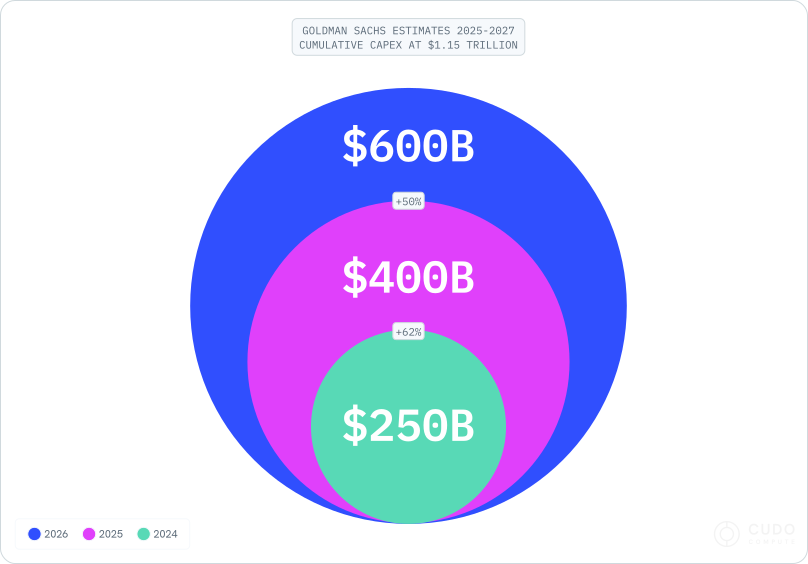
That assumption is now at odds with reality. In 2024, the four largest hyperscalers (Amazon, Google, Meta, and Microsoft) spent more than $250 billion on capital expenditures, up 62% from the prior year.1 In 2025, that figure surged past $400 billion.2 Projections for 2026 now exceed $600 billion.3 Goldman Sachs estimates that total hyperscaler capex from 2025 to 2027 will reach $1.15 trillion, more than double the $477 billion spent from 2022 to 2024.4
Yet facilities can’t be built fast enough, or are on sites where grid interconnection has slipped by years. In Santa Clara, California (NVIDIA’s own backyard), nearly 100 MW of newly constructed data centres sit empty, awaiting power connections that may take years to materialise.5
The bottleneck is no longer GPUs. It’s land, power, and the physical infrastructure required to convert hardware into usable intelligence. Power increasingly dictates the cost structure of compute.
Where things are breaking down

GPUS secured too early
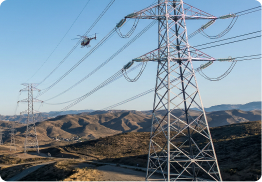
power not available
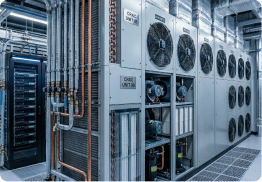
cooling not designed
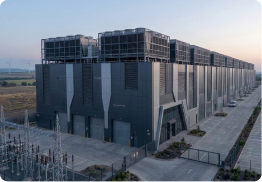
Timeline misaligned
Demand on the physical world is unprecedented. According to the International Energy Agency, data centres consumed approximately 415 TWh of electricity globally in 2024 — about 1.5% of total global consumption — a figure that will more than double to 945 TWh by 2030, slightly exceeding Japan’s current annual electricity consumption. The United States alone accounted for 45% of global data centre electricity consumption in 2024. By 2030, the country is set to consume more electricity for data centres than for the production of aluminium, steel, cement, chemicals, and all other energy-intensive goods combined.6
The shift is structural as training a frontier model now requires sustained power loads of tens to hundreds of megawatts. Recent training runs comparable to GPT-4o – a model now out of date by several cycles – consumed 20-25 megawatts continuously for approximately 3 months.7 With increasing ‘brain’ power comes increasing power demand: by 2028, individual frontier training runs are projected to require 1 to 2 gigawatts; by 2030, that figure could reach 4 gigawatts.8 Deploying these models for inference at scale requires distributed infrastructure spanning continents, with facilities managing thermal densities that have increased by an order of magnitude: from 10 to 15 kW per rack in air-cooled environments to 100 to 200 kW today using direct liquid cooling, with next-generation systems pushing toward several hundred kilowatts.9
The grid is straining to keep up. Lawrence Berkeley National Laboratory’s most recent analysis found that, by the end of 2024, roughly 2,300 GW of proposed generation and storage capacity was actively seeking grid interconnection — nearly double US installed capacity, even after the queue’s first year-over-year decline in at least a decade.10
Waitlists in Northern Virginia, one of the world’s largest data centre markets, stretch to seven years. The queue is compounding rather than clearing: in February 2025, Dominion Energy Virginia reported that data centre firms had requested 40.2 GW of power connections, up from 21.4 GW just seven months earlier.11
The end of effortless scaling: when infrastructure stopped keeping up
Cloud computing – where companies migrated storage and processing from on-premises servers to hyperscale data centres operated by Amazon, Google, Alibaba, and Microsoft – accelerated through the 2010s and early 2020s. Still, total data centre power demand remained remarkably flat. Efficiency gains in servers, storage, and cooling offset workload growth almost exactly. The infrastructure kept pace with the software, but that relationship has now reversed.
While cloud workloads scale horizontally across commodity servers, AI workloads scale vertically into dense, tightly coupled clusters that stress every layer of the physical infrastructure simultaneously. The efficiency gains that kept cloud-era power demand flat have largely already occurred, making the infrastructure required for AI structurally more resource-intensive.
Businesses shifted from local servers to global hyperscale data centers
Modern AI broke the efficiency cycle and need physical infrastructure
Quantifying the new constraints
Our data from 701 infrastructure decision-makers show that AI model performance ranks as the single highest barrier to scaling workloads at 36.2%, with GPU cost and availability close behind. Yet infrastructure constraints — power, land, cooling — collectively dominate as a category, reinforcing that the challenge is not any one bottleneck but the compounding effect of physical constraints across the stack.
What most limits the ability to scale AI workloads?
Respondents selected up to 3 factors | n = 701 | Infrastructure accounts for 50% of all selections
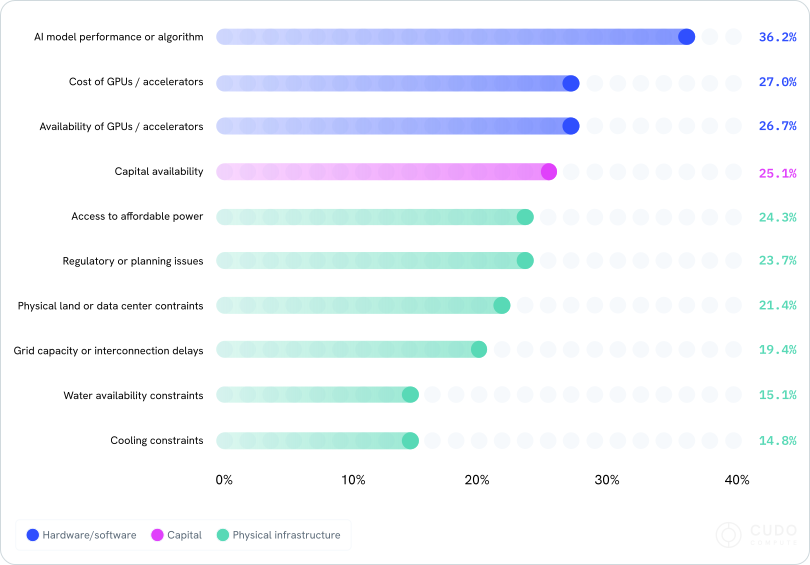
Power affordability, regulation, land, grid access, water, and cooling collectively account for half of all scaling constraint selections compared to just 38% for hardware and software combined. When it comes to infrastructure, organisations are not hitting one single wall. They are hitting multiple physical limits simultaneously, and the accumulation of these factors defines the true bottleneck.
"We see a 'cascade effect' where delivery orders against clients are missed because the initial schedule was built on optimism rather than de-risked infrastructure."
BEN STIRK
Capital outpaces physical readiness
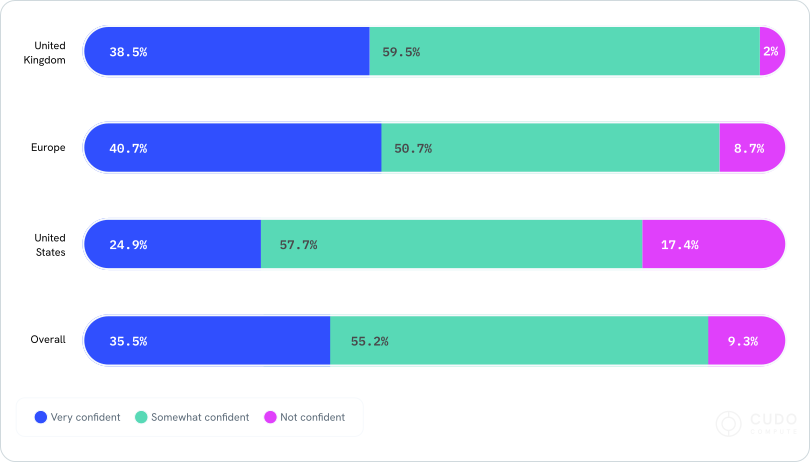
Across all three markets, 90.7% of respondents reported confidence in their organisational understanding of capacity planning and the physical requirements for scaling AI. This figure reached 98% in the UK, compared to 82.6% in the US, creating a paradox in which the market committing the most capital to AI infrastructure reports the weakest grasp of what it physically takes to deploy it.
Confidence in capacity planning for AI scale
71%
Infrastructure-driven cost
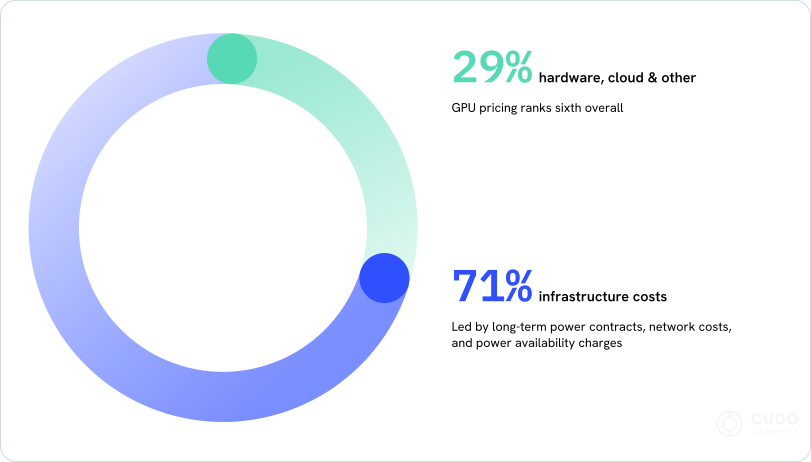
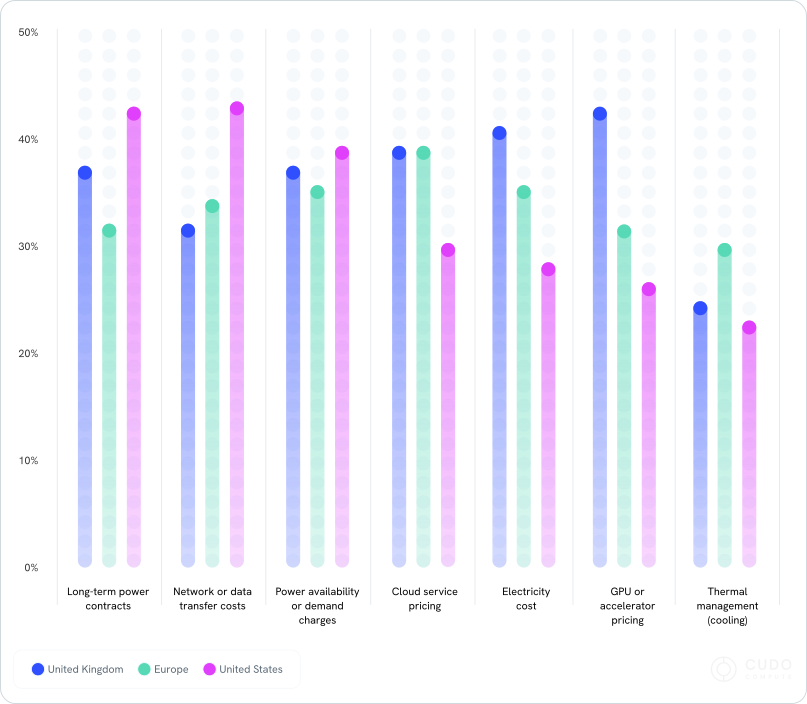
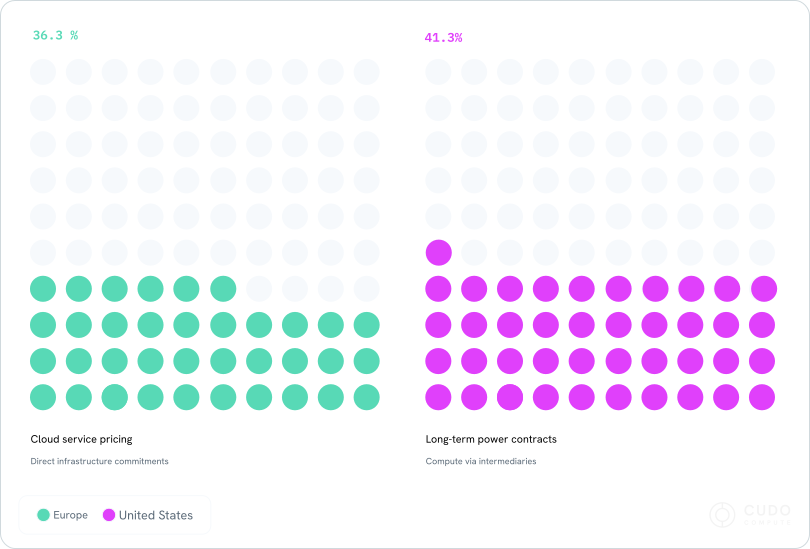
Infrastructure already accounts for 71% of all cost-driver selections, led by long-term power contracts, network costs, and power-availability charges, while GPU pricing ranks sixth. The cost of scaling AI is fundamentally an infrastructure cost, even in markets where the public conversation still centres strictly on chips.
What drives the cost of AI compute?
The gap between capital deployment and physical reality remains wide. Radu Toncu, CMO at ClusterPower, pointed out, “We have seen quite a few projects in the market that claim to be ready to start. They have nice PowerPoint slides, but when you look at the details, you see that they don’t have the necessary permits, the grid capacity and reliability are not that great, and the parties involved don’t necessarily have the experience required for AI.”
- Confidence is not capacity
Across the survey, confidence in capacity planning runs high — 98% in the UK. But confidence does not equal capacity. Matt Hawkins, CEO of CUDO, saw the gap between the two translate directly into offshore leakage. “Most of the resources are consumed in the US, then Europe, then APAC. Right at the back of the pack is the UK. It’s partly due to grid costs and a lack of data centre capacity. We’re having to put clusters offshore, and we don’t want to be doing that.”
The survey suggests that the UK understands what it takes to scale AI. Its operators are already building elsewhere.
Energy dictates the cost structure
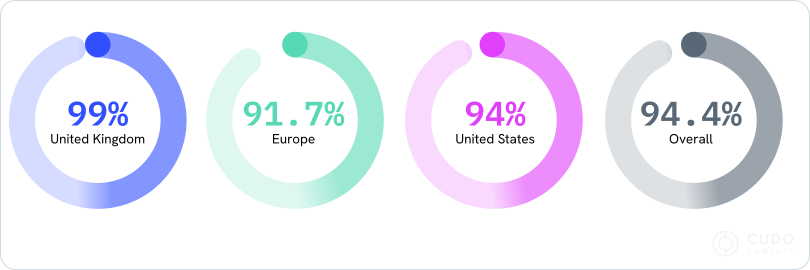
Energy procurement is a core part of AI strategy: 94.4% of respondents globally, and 99% in the UK, said so. Yet fewer than a third of respondents reported that energy pricing actively shapes their investment decisions.
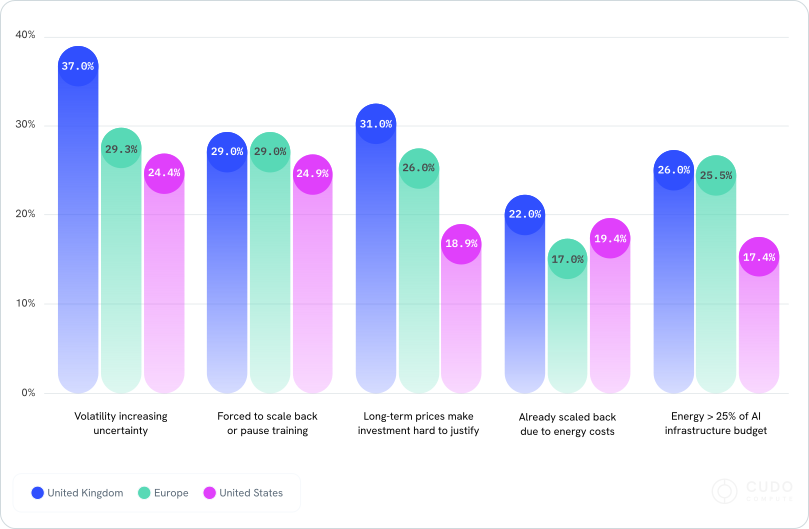
Roughly one in five organisations has already altered AI workloads due to energy costs. Across all three markets, 23.3% reported that energy consumes more than a quarter of their AI infrastructure budgets. The industry has recognised the problem, but has not fully reorganised around it.
The deployment divide
Among AI-first companies, 99% report high confidence in their capacity planning, with 49% very confident. Enterprise confidence sits at 83%, with only 22% very confident and 17% reporting outright low confidence. The organisations furthest along in deployment are the most certain about the physical requirements, while those earlier in the cycle remain the least prepared for what they will inevitably encounter.
Energy procurement operates as a core strategic function for 70% of AI-first firms. Among enterprises, only 30% treat it the same way, while 60% classify energy procurement as circumstantial and 9% say it plays no role in their AI strategy at all. AI-first developers have already learned that energy dictates deployment viability, whereas, in aggregate, enterprise buyers have not.
AI-first companies rank GPU availability as a top-three scaling constraint at 34%, which is 15 percentage points above the enterprise rate. AI-first firms face hardware scarcity because they place orders at scale. Enterprises encounter regulatory and planning friction first because they have not yet reached the operational stage where hardware and power constraints truly bite.
Scarcity of viable sites
Very little of the world’s available acreage can actually support an AI workload at scale. A viable site must simultaneously offer grid access with sufficient capacity, cooling and water feasibility, resilient fibre connectivity, regulatory certainty, room for expansion, and a low risk of natural disasters.
Although physical land constraints rank as a scaling barrier for 21.4% of respondents overall, regulatory issues sit higher at 23.7%, and grid capacity delays follow at 19.4%. On its own, land is not where organisations report the biggest challenges. It’s the required permits, grid connections, cooling water, and fibre routes.
Among AI-first companies, power availability blocks deployment at 40%, compared with 24% for enterprises. Every other deployment blocker also ranks higher among AI-first respondents, except for budget approval timelines, where the two groups tie at exactly 28%. Enterprises report greater friction in regulatory and planning processes because AI-first firms have already bypassed the paperwork and are now hitting the hard physical limits of power, cooling, and grid access.
For Richard Collar, VP Customer Solutions at Kao Data, “the inside of the data hall is becoming standardised” while “everything from the fence line outward remains tightly constrained by local utility and regulatory realities.” Internal facility configurations are converging, but the external factors determining site viability have not.
The biggest challenges are
Permits
Grid connections
Cooling water
Fibre routes
The exhaustion of established hubs
In terms of factors likely to delay or prevent deployment in their preferred location, 26% of respondents cited planning and regulatory timelines. Chris Milner and Michael Harman at Holmes & Hills Solicitors mapped the legal mechanics behind this friction. The planning system is a primary obstacle because “many local planning authorities are chronically under-resourced, resulting in inconsistent and slow decision-making processes.”
In the UK specifically, grid connection delays rank third at 27.5%, and 21% of respondents cited the lack of suitable land: the highest rate of any region. The places where digital infrastructure has historically been built are simply running out of room, power, or both
Land-adjacent deployment blockers by region
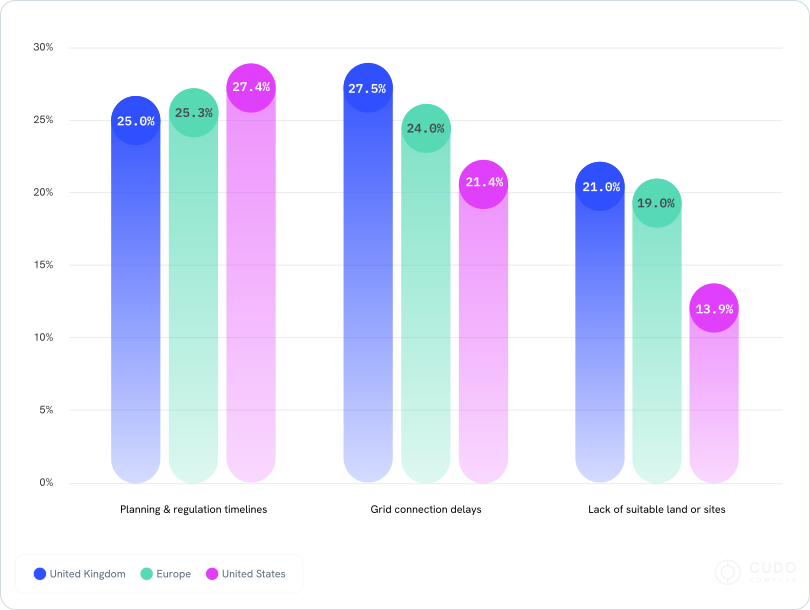
Duncan Clubb, Senior Partner at Cambridge Management Consulting, observed this shift across the European market: “The traditional approach of putting data centres in places like Slough made sense a few years ago. Nowadays the substations there are basically full with very limited options — nowhere near enough to satisfy demand.” And regional variations abound, as seen in the chart above.
"In data centre projects, even the slightest detail can cause delays, whether it's technical, related to the supply chain, personnel, state oversight, or anything else. One anecdotal reason for delivery delays is the proverbial 'ceramic shard'.
When breaking ground, if any historical artefacts are found, construction is halted until archaeologists clear the site of any potential finds. Archaeology has its own pace, which does not align with AI."
Radu Toncu
Power availability dictates location
33.7%
Say power is the main factor in location decisions
Organisations increasingly prioritise grid capacity over customer proximity, making power availability the leading factor in location decisions at 33.7%.
Clubb highlighted this reversal in planning logic, noting that developers are now building data centres where the power is rather than bringing power to the data centre.
For massive gigawatt-scale facilities, the only real solution is to go where the power is generated. This shift accelerates as latency constraints loosen, the need for proximity to internet exchange hubs fades, and hyperscalers actively look beyond traditional tier-one markets.
Marc Garner, Global President, Cloud & Service Providers at Schneider Electric, framed the same dynamic in deployment terms: “Developing a robust energy strategy is now one of the prerequisites for AI-ready data center deployments, and at Schneider Electric, we see a major trend of operators deploying large-scale AI workloads in hubs across the Nordics and Southern Europe, where access to powered land and low-cost renewable energy is readily available.”
But building in power-rich regions results in high hidden costs, as remote sites lack resilient connectivity, local supply chains, and community acceptance. Operating an AI data centre requires a highly specialised workforce to manage both the mechanical systems and the complex compute hardware – with operational teams shipped in and housed nearby.
Even where developers accept these trade-offs, the site remains theoretical without secured power. As Ben Stirk, Head of Enterprise and AI at Ark Data Centres, put it, “If you don’t already have power secured for a site, or if you haven’t already placed the orders to get it there, you aren’t just behind. You aren’t even in the race.”
Sites with secured power remain vulnerable to risks outside the operator’s control. Pete Hill, VP of Business Development at CUDO, recalled, “We were close to progressing with a site in the Nordics with 800MW+ grid underwriting in place and a major GPU deployment on the line. Then a rare animal was spotted in the area. Under local environmental law, everything stopped. It didn’t matter what our timeline was or who the customer was; ecological compliance doesn’t care about your AI roadmap. We had to develop multi-site contingency plans overnight.”
Power is the new pricing layer of AI
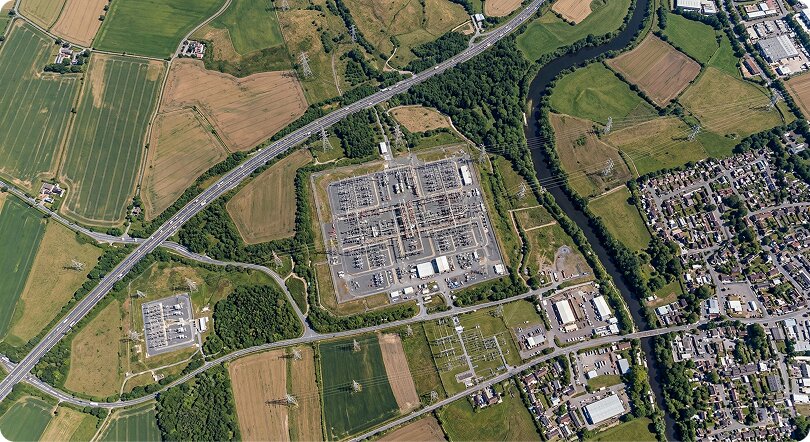
The amount of power a site can receive and exactly when it can receive it are the big blockers for AI at present. UK operators face national grid upgrades that might not materialise until 2030 or 2031, and the queue is not clearing.
The legal framework governing grid access actively compounds this physical constraint. Harman and Sophie Bennett, Associate in Construction at Holmes & Hills Solicitors, explained that the recent shift from a strict queue to a “first ready and needed” model via a new Gate system offers only marginal relief for large energy-demand projects. Data centres still face a complex application process in which “projects can be waiting up to 15 years for connection.” This uncertainty leads to speculative applications that clog the queue, making it impossible for contractors to program construction work accurately.
“Nowadays the substations are basically full with very limited options, nowhere near enough demand to satisfy demand.”
CAMBRIDGE MANAGEMENT CONSULTING
Power availability is the most cited deployment blocker across all three surveyed regions, at 32.1%, rising to 38.5% in the UK. Grid connection delays add another layer of friction, at 24.3% overall and 27.5% in the UK, underscoring that the cost structure of AI at scale is fundamentally tied to energy. Three of the top five cost drivers identified by respondents remain strictly power-related, led by long-term power contracts at 35.7%, while GPU pricing ranks sixth at 32.0%.
Most UK operators are either sitting on existing capacity or staring down grid timelines that stretch five to six years into the future.
Jack Halstead, Chief Commercial Officer of Novara Infrastructure, captured this customer-side disconnect: “There is a huge gulf between when customers want capacity online to run hardware that was only released a month ago and real-world development cycles,” he explained. The reality dictates that “syncing expectations between users and infrastructure providers/developers is critical” to successfully bridge this gap. Because GPU delivery operates on a quarterly basis, whereas power delivery operates on a multi-year basis, the structural mismatch between the two completely defines the shape of every project attempting to bridge them.
Anushka Devaser, Technical Director of Sustainability Advisory at WSP, identified a further layer of complexity that comes from the misconception that power procurement is purely about cost or megawatt capacity. AI workloads, however, are highly sensitive to interruptions, where even millisecond-level disruptions can compromise weeks of training.
1 in 5 organisations are already adjusting workloads due to energy constraints
Grid connection timelines can extend up to 15 years in key markets
Infrastructure › hardware
What drives the cost of AI compute?
Escaping the interconnection queue
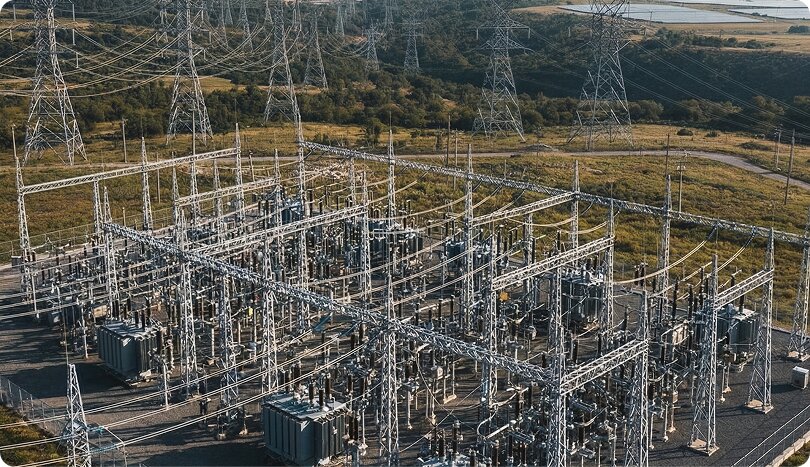
Finding alternatives to skip the queue is therefore needed. On-site gas generation is already the default approach in the US for large builds. Despite the environmental trade-offs, Clubb said gas remains one of the few methods capable of delivering large amounts of power quickly. Hydrogen fuel cells offer a greener but highly expensive path, while hyperscalers bypass the grid entirely by acquiring decommissioned nuclear stations to secure gigawatt-scale capacity in a single location.
Alternative off-grid routes come with legal friction. Pursuing a private wire connection to a local energy source requires easement agreements from every intervening landowner, rendering the route commercially unviable if any single party adopts a “ransom” position.
Off-grid generation can be significantly cheaper than purchasing electricity from the grid, directly incentivising developers to build alternatives even when a connection might eventually materialise. “Behind the meter generation allows operators to control their timelines, removing uncertainties and delays caused by network operators,” said Novara Infrastructure’s Halstead. In high-cost environments like the UK, this approach “will invariably be cheaper than grid power, meaning the commercial proposition to the end user is more attractive to market peers and allows the DC to compete on an international stage.”
While a proper grid connection remains the gold standard for built-in resilience, intense commercial pressure measured in quarters forces off-grid alternatives to become the primary deployment strategy.
- The hidden cost underneath the power cost
The grid queue dominates the conversation, but the supply chain underneath it is equally binding. Tim Dyce, CUDO’s Chief Technology Officer, flags the constraint most operators miss. “Transformers and high-voltage switchgear now take 18 to 24 months from order to delivery. If you haven’t placed those orders before you’ve finalised your site, you’ve already lost a year. The supply chain for mechanical and electrical plant is the constraint that sits underneath the power constraint.”
Securing a grid connection means nothing if the physical equipment needed to receive it hasn’t been ordered. Operators planning power strategies in megawatts must simultaneously plan procurement strategies in months, or the grid connection date becomes theoretical.
Ben Pritchard, CEO of AVK, described how this shift is driving operators toward full energy independence. “Waiting for a grid connection now isn’t an option. There is limited visibility about when a grid connection may become available for data centre operators, which is why many are now starting to direct their attention to alternative technologies, such as microgrids.” Data centres traditionally clustered in hubs such as Frankfurt, London, Amsterdam, Paris, and Dublin because grid connectivity was not an issue. Now, operators must go where the power is, leading to facilities emerging at the edge of hubs rather than within them. For Pritchard, microgrids resolve both constraints simultaneously: “Data centres can be situated where the land is most suitable, with independent power generation.”
Developers are actively deploying AI for predictive analytics to prioritise land acquisition, forecast generation needs, and balance the grid. For Simon Muskett, Principal of AI & Quantum at Digital Realty, this dynamic gives rise to new approaches, ranging from small modular reactors (SMRs) to the use of compute for grid balancing. The fundamental paradox remains: the tools deployed to solve the power constraint are themselves power-intensive.
"The biggest misunderstanding is assuming securing power is only about price or MW capacity. AI loads are extremely sensitive to even millisecond-scale interruptions, and the engineering required to deliver truly firm, uninterrupted supply is often underestimated."
ANUSHKA DEVASER
The map follows the megawatts
Power availability and grid capacity have overtaken traditional metrics as the leading factors in location decisions for 33.7% of respondents. Because nearly a third of developers expect energy availability to matter more than talent or regulation when choosing where to place future workloads, site selection no longer prioritises proximity to users or internet exchange hubs. Developers now ask where they can secure power fastest.
In the UK, 40.5% of respondents identify power and grid capacity as key location constraints, while energy costs limit expansion for 32.5%. A quarter of respondents consider moving AI workloads out of the country entirely due to high power costs. Although the UK government prioritises AI sovereignty, the national grid structurally cannot support the infrastructure required to achieve it.
Power is redrawing the map of AI deployment
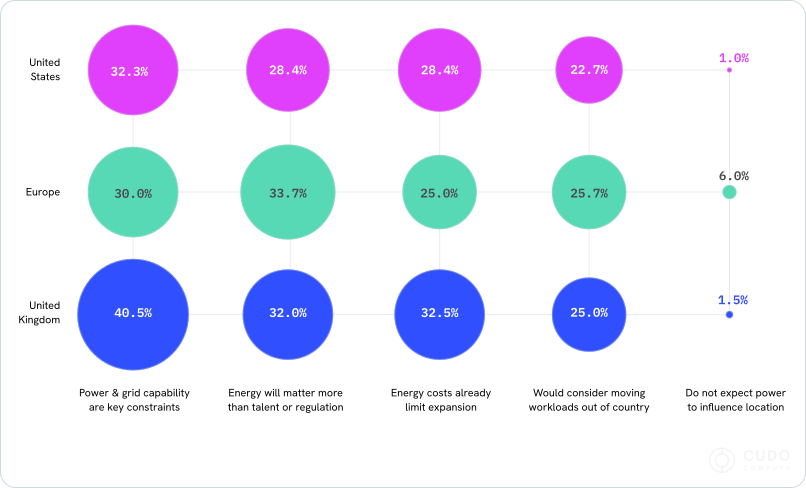
Energy procurement is treated as a core part of AI strategy by 94.4% of respondents globally, rising to 99% in the UK, yet this broad strategic recognition rarely translates into operational adaptation.
Percentage that say energy is part of their AI strategy
Percentage that say energy costs are already constraining operations
Thermal management: the hidden infrastructure layer
Since a single AI training rack now draws 100 kilowatts or more, the heat produced per square metre far exceeds anything conventional data centre cooling was designed to handle, meaning even the most aggressively optimised air movement cannot remove heat fast enough. Muskett identified the exact inflection point at 30 to 40 kilowatts per rack, noting that while advanced air-cooling methods, such as cold-aisle containment, remain viable below that threshold, thermodynamics strictly mandates liquid cooling above it.
Luc Yu, Vice President at Supermicro, mapped the continuation of this exact density curve to show what happens at the extremes. The firm observed that at 40 to 60 kilowatts per rack, cooling feasibility begins to dominate site selection, replacing land and the power grid as core considerations. Once densities reach 80 to 100 kilowatts, liquid cooling becomes mandatory, and site selection is determined solely by heat dissipation conditions and water resources.
The global inventory of sites equipped with direct liquid cooling capability remains severely constrained, making the speed at which new liquid-ready capacity can be built a strict physical bottleneck. Richard Collar, VP Customer Solutions, Kao Data described how the market has coalesced around liquid-ready mechanical infrastructure and scalable power blocks as the new baseline for AI-capable facilities, even though colocation designs have not become fully uniform.
Grid capacity, water availability, climate, refrigerant regulation, and local planning conditions continue to force one-off engineering choices at every single site, creating a distinct pattern of standardisation within the data hall while everything from the fence line outward remains tightly constrained by local utility and regulatory realities.
Hardware architectural roadmaps strictly dictate these physical changes. Clubb described NVIDIA’s megawatt-per-rack announcements as “absolutely bonkers” amounts of energy in a very small space, requiring a completely different approach to data centre design. Because each successive GPU generation drastically increases thermal output, facilities designed for today’s density will inevitably encounter cooling limits within one or two hardware refresh cycles.
“The announcements from companies like NVIDIA are deeply concerning sometimes when they say we’re looking at a megawatt per rack, absolutely bonkers amount of energy in a very small space.”
CAMBRIDGE MANAGEMENT CONSULTING
As thermal limits now dictate viability, Yu argued that relying on Power Usage Effectiveness remains fundamentally misleading for AI workloads. PUE fails to reflect power density and performs exceptionally well only at full load, thereby concealing inefficiencies at partial load. PUE also fails to capture water consumption and space utilisation, demonstrating that the industry must look beyond legacy efficiency metrics when evaluating high-density facilities.
Cooling and water scaling limits by region
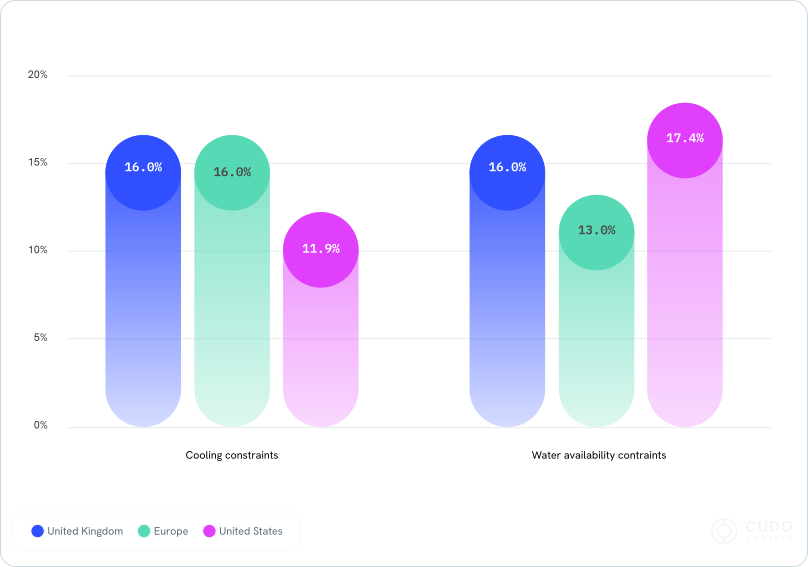
Cooling and water cost drivers by region
24.5%
30.3%
23.4%
Cooling and water blocker by region
18.5%
United Kingdom
25.3%
Europe
22.9%
United States
When asked which factors have the greatest impact on total AI compute cost, regional differences in cooling stand out sharply. Thermal management costs reach 30.3% in Europe compared to 24.5% in the UK and 23.4% in the US.
European operators building at higher densities or in warmer climates sit further along the cooling curve than their UK and US counterparts, as evidenced by cooling and water constraints blocking deployment for 25.3% of European respondents — nearly seven percentage points above the UK rate.
The operational gap in liquid deployment
While deploying a single liquid-cooled rack remains an engineering problem with known solutions, operating hundreds of them across a campus to manage peak demand and strategic cluster placement represents an operational problem the industry is still actively solving.
Yu identified the specific unresolved issues preventing large-scale applications, pointing to severe incompatibility among multi-vendor equipment, imperfect long-term water quality control, and extreme difficulty in fault location when local problems rapidly spread. Capturing the inherent efficiency of liquid cooling requires a level of operational maturity that most facilities have simply not yet achieved.
Water scarcity and correlated failure modes
Water concerns are driving a strict structural shift toward closed-loop systems with near-zero Water Usage Effectiveness. Collar noted that facilities designed today actively avoid architectures creating long-term water dependency in regions where supply, permitting, or public scrutiny may suddenly tighten.
Regional climate differences directly compound these structural shifts. Yu noted that under high-temperature weather, extreme grid strain coincides exactly with peak cooling demand. Operators are forced to sacrifice efficiency by activating backup cooling or limiting loads to keep critical services operational. Climate, therefore, dictates which cooling architectures remain viable under sustained load over the multi-decade lifecycle of a facility rather than acting as a mere secondary consideration in site selection.
The final infrastructure bottleneck
26%
of aI-first firms have deployment blocked by cooling and water
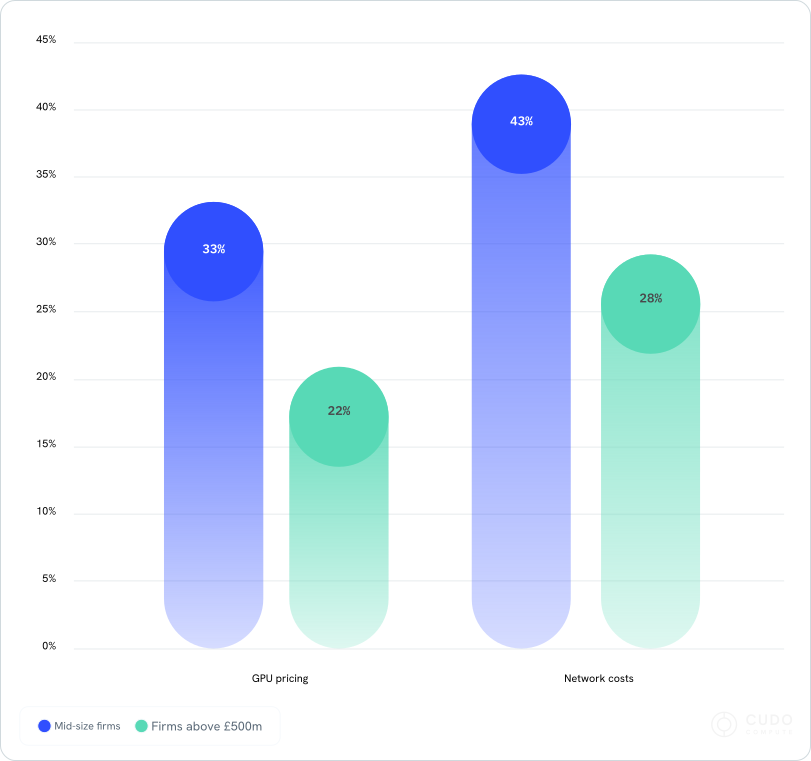
Cooling and water constraints block deployment for 26% of AI-first firms compared with 19% of enterprises. This perfectly aligns with the pattern across all infrastructure layers, as AI-first companies encounter physical limits more acutely when deploying at much higher densities. Revenue scale compounds the effect in the exact opposite direction. Among organisations with turnover above £500 million, only 8% cite cooling as a scaling constraint, compared with 17% for mid-sized firms.
"Those pushing the most advanced AI require infrastructure operating at power densities that demand a fundamental rethink of thermal management - at 100 kilowatts per rack and beyond, the physics of conventional cooling simply break down. But thermal management is only part of the challenge; the cutting edge also demands access to large amounts of power and low-latency connectivity. Together, these three constraints have become the primary drivers of site selection, because the pace at which you can deliver all three determines how quickly the entire ecosystem can generate value."
SIMON MUSKETT
Compute: scaling AI under constraint
GPUs are arriving faster than the buildings can absorb them. Organisations frequently secure large allocations only to deliver hardware to facilities incapable of sustaining the cluster at full load. ClusterPower, Cambridge Management Consulting, and Ark Data Centres each independently identified this stranded compute as a defining pattern across the industry.
GPU-ready data centres differ fundamentally from traditional facilities. GPU clusters require special operating conditions in which power, cooling, networking, and redundancy all demand reinvention — simply increasing power density and cable sizing is not enough.
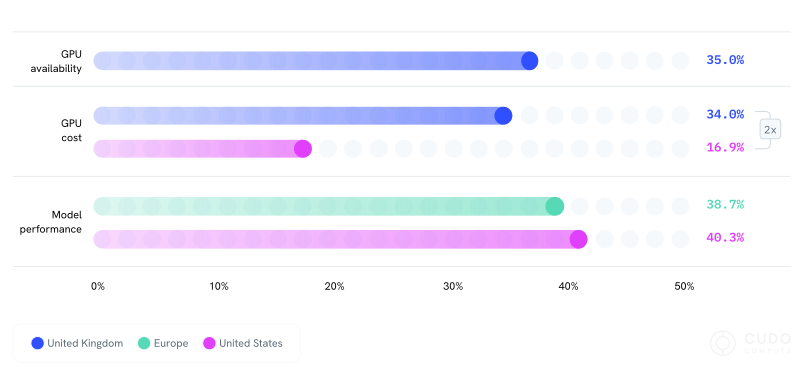
GPU availability ranks among the top-three scaling constraints for 26.7% of respondents overall, though AI-first companies cite it at 34%, 15 percentage points above the enterprise rate. Yet 36.9% of all respondents cite rapid GPU investment without matching infrastructure readiness as a primary driver of bubble concerns, a share that rises to 40.0% in the UK.
Top scaling constraints by region
"Traditional assumptions are no longer valid. Instead of designing for IT loads that adapt to your building, you design the building around the physics and operational realities of AI systems."
RICHARD COLLAR
The system around the silicon
The physical system supporting the GPU now costs more than the silicon itself. Network and data transfer costs rank second overall among cost drivers at 35.5%, ahead of GPU pricing at 32.0%, and this gap widens to 40.3% versus 25.9% in the US market. Among AI-first companies, network costs reach 41%, compared to 30% for enterprises, reflecting the highly distributed, multi-site architectures these firms must operate to aggregate sufficient power.
Resilient high-speed connectivity ranks as a deployment blocker for 29.4% of US respondents, trailing only power availability, and is the only deployment blocker where enterprise and AI-first respondents remain statistically even at 24% and 25%, respectively. While every other physical constraint hits AI-first firms harder, the strict requirement to move large volumes of data binds all deployments equally.
Cost drivers diverge as organisations scale
Infrastructure dictates hardware
Training is compute-bound, while the decode phase of inference is memory-bandwidth-bound. These represent fundamentally different hardware problems. NVIDIA’s forthcoming Rubin family reflects this divergence: the standard Rubin GPU, with HBM4 and NVLink, targets training and decode, while the Rubin CPX — a lower-cost, GDDR7-based chip without NVLink — is purpose-built for the compute-heavy prefill phase. The Vera Rubin NVL144 CPX rack combines both in a single system, with general availability expected at the end of 2026. This architectural split means operators can match silicon to workload phase rather than over-provisioning expensive hardware across the entire inference pipeline.
The era of homogeneous, single-vendor data centres is ending because modern AI inference workloads span compute-bound prefill and memory-bound decode stages — and multimodal agentic pipelines add further diversity in the form of diffusion, vision, and speech workloads. Each stage has a different optimal silicon. Adding mid-tier memory-optimised GPUs to an H200 cluster and using orchestration software to route workloads to the right silicon yields more than a 2x performance improvement over a homogeneous configuration.
NVIDIA’s shift from standalone GPU servers to tightly coupled CPU-GPU systems — exemplified by the Grace Blackwell NVL72, which pairs one CPU with every two GPUs — reflects the growing role of CPUs in managing inference, memory orchestration, and cluster control.
Greg Ernst, Chief Revenue Officer at Intel, captured this trend: “In an AI world of agentic and inference workloads, CPUs are having a resurgence and not just because of orchestration and app calls. With large-scale AI inference, data handling, RAG, and reinforcement learning simulations all matter and require CPU capacity. In short, a higher CPU-to-GPU ratio is critical to deliver the best performance and TCO across the data centre.”
- Match the hardware to the workload
Buyers do not need to become GPU experts, but they must translate hardware specifications into business outcomes. Frontier training demands extreme compute density. Agentic inference and massive-context processing demand memory-rich platforms. Sovereign or localised workloads frequently achieve their best cost-to-performance ratio on mature, available hardware rather than queuing for the latest silicon.
Failing to map infrastructure to the specific workload guarantees misallocation: a high-density training cluster running basic inference, or a training run starved of bandwidth because the facility was designed for a different thermal profile.
The facility is the product
Because infrastructure outlives the hardware by an order of magnitude, the facility serves as the permanent product, while the compute hardware cycles far more frequently. Older GPU generations retain useful life, particularly for inference, but frontier operators prioritise the most current hardware for training and large-scale deployment. The capital expense of IT equipment now exceeds the cost of the building by a factor of three to ten, reversing the traditional relationship, and the depreciation gap has forced the industry to adopt entirely new structures.
Collar and Kao Data responded by designing facilities that can accommodate whatever hardware ships next, rather than anticipating its specifications. The approach combines flexible cooling systems, variable power densities, and modular layouts that can be reconfigured as each GPU generation arrives. For Collar, the designs that have aged the worst are all rooted in the error of building for stability in an environment that changes every twelve months.
Finance: the invisible constraint on AI scale
While most physical constraints analysed in this report split sharply between AI-first companies and enterprises, finance does not. Capital availability ranks as a scaling limit for 25.1% of respondents overall, sitting at 26% for AI-first firms and 24% for enterprises.
Budget approval timelines block deployment for 28% of both groups, while uncertainty around long-term AI returns sits at 30% and 29%, respectively. Although deployment maturity strictly determines which organisations feel physical pressures, financial pressure remains structurally universal.
25.1%
overall rank capital availability as a scaling limit
28.0%
overall say budget approval blocks deployment
The depreciation mismatch
The market incorrectly treats AI infrastructure as a monolithic investment. A data centre shell, its power infrastructure, and the compute hardware inside it represent fundamentally different asset classes operating on conflicting timelines.
While the facility shell represents a traditional real estate asset with a twenty to thirty-year horizon, power infrastructure operates as an energy utility requiring multi-decade commitments. Compute hardware follows a three-to-five-year lifecycle with rapid generational performance gains. Attempting to finance all three distinct timelines under a single traditional data centre model fundamentally breaks the risk calculus.

Jack Halstead detailed the mechanism by which this mismatch kills projects: power and permitting act as the massive gates early in development, but financing at the back end is not straightforward because “the rapid GPU evolution means customers are unwilling to sign long-term master service agreements (MSAs) and contract ahead of the capacity being rack-ready.” Technology marches on, making it increasingly difficult to align the buyer and the infrastructure provider.
This severe depreciation mismatch amplifies risk and destroys operational flexibility because investors must deploy multi-decade infrastructure capital to house short-term consumable assets. The neocloud sector has responded with entirely new funding structures. Cambridge Mangaement Consulting’s Clubb identified more than 180 neocloud companies offering GPU-as-a-service, observing that “not one of them is realistically more than a couple of years old.”
"Investors are really warming up to this market. The real shortage isn't capital, it's neoclouds with bankable, contracted customers. There's more appetite from investors for these assets than there are execution-ready deals. The sticking point is always converting a nice pipeline into a signed offtake agreement, and that always takes longer than people think."
NICK HENSHAW
The circular dependency
Financing each layer (data centre, power, and hardware) separately creates a dependency loop that stalls the market. “The compute itself is great, but without power it isn’t valuable,” said James Marks, Founder & CEO, Canopy Cloud. Capital providers must understand the entire integrated stack to price risk accurately because “a data centre that isn’t occupied or isn’t full is worth nothing.”
Capital providers demand offtake certainty before committing funds, while offtakers refuse to sign agreements until they have absolute infrastructure certainty. Concurrently, power providers require long-term demand assurance before investing in grid upgrades. Each party in the chain waits indefinitely for the others to move first. Ultimately, capital flows exclusively toward projects backed by the credit quality of a contracted offtaker. Without a highly creditworthy tenant signing a binding agreement, the debt required to build the facility simply does not exist.
Halstead described the fix from the infrastructure provider’s side: “Having a clear framework in agreed form as early as possible is what matters, [because] financing the build of hundreds of millions or billions of dollars worth of data centre requires buyers to understand the financing and build timelines, which are much longer than compute timelines.”
Marks addressed the filtering mechanism, “Capital is easy to find, but without clear plans or backing from a major tech provider, it is difficult to obtain.” Financiers are not interested in future projections. They ask developers, “What do you actually have now?” and require a track record of delivering sites and meeting promised timelines.
Nick Henshaw, Finance Executive, confirmed this dynamic from the capital markets. “Investors are really warming up to this market. The real shortage isn’t capital, it’s neoclouds with bankable, contracted customers. There’s more appetite from investors for these assets than there are execution-ready deals.” The gap between pipeline and commitment remains the structural bottleneck. “The sticking point is always converting a nice pipeline into a signed offtake agreement, and that always takes longer than people think.”
- What "execution-ready" actually means
Capital availability constrains 25% of respondents, but the bottleneck is not the supply of capital. It is the supply of projects that can absorb it. “Capital flows toward projects with creditworthy, contracted demand,” according to David Bell, CUDO’s Chief Financial Officer. “It’s the credit quality of the offtaker that actually unlocks the financing.”
Execution-ready is not a pitch deck with a power target. It is land secured, grid committed, offtaker contracted, and equipment on order.
How capital actually shows up
As the risk profile has shifted, AI infrastructure requires utility-style financing rather than venture logic. Access to finance blocks deployment for 22.4% of respondents overall, but this rate drops to 18.4% in the US, where deeper capital markets and established infrastructure financing mechanisms effectively reduce friction.
22.4%
overall say access to finance is a blocker
Marks expected a hybrid financing model to ultimately prevail: “Infrastructure funds know how to build, how to source the power, and hyperscalers know the customers. The hybrid model will win if parties can execute quickly.” Assembling this exact financial coalition remains the primary hurdle. Henshaw challenged the assumption that compute has already become a utility — a standardised commodity bought by the unit at predictable prices.
“There’s a narrative about compute becoming a utility, but the equity in these businesses still performs like a growth investment. The public neoclouds trade at the opposite end of the spectrum from sleepy infrastructure companies.” Infrastructure investors participate on the debt side, financing individual contracts, “but the equity story is firmly in VC and growth investor territory for now.”
Leading cost driver by region
Finance as the final filter
Energy price uncertainty challenges data centre development. In the UK, 31% of respondents state long-term energy prices make AI investment difficult to justify, compared with just 18.9% in the US. Greg Moss, Founder and CEO of CloudAdvise, put a number on the threshold. “I’m not sure the industry has truly stress-tested what power costs do to AI profitability. My read is that you need to be sub-$0.09/kWh all-in, including PUE, to make the economics work.”
The organisations closest to the power constraint experience capital constraint most acutely, as evidenced by the Energy and Utilities sector, which ranks capital availability as a limiting factor at 47%, nearly double the overall average. Capital availability gradually eases with scale, dropping from 25% at mid-sized firms to 21% at those above £500 million, yet one in five of the largest respondents still cites it as a hard-limiting factor.
Ultimately, some technically viable projects will never be built. They will fail because the capital structure required to perfectly align all three physical elements –land, power and cooling – on the same site within the same timeline never materialises. Finance is the gatekeeper selecting which projects proceed and which remain permanently grounded.
The geopolitics of AI
Only 4.3% of respondents report leaving their approach to AI infrastructure location unchanged in response to geopolitical conditions. The remaining 96% actively adjust where they build, what they prioritise, and how they balance economics against sovereignty. The geopolitical competition surrounding artificial intelligence increasingly resembles a new space race in which computing power is the ultimate strategic asset.
China’s rapid advances in foundation models and domestic silicon fabrication have forced Western governments to view data centres as critical national security assets rather than mere commercial real estate.
The majority are adjusting
Geopolitics as infrastructure policy
The policy landscape driving this adjustment relies on physical constraints rather than digital firewalls. Planning law, environmental regulation, and utility moratoria operate as the primary instruments of geopolitical control. Dublin imposed an effective moratorium on new data centre grid connections after these facilities accounted for 22% of Ireland’s national electricity consumption 12.
The total number of Dutch data centres fell below 2019 levels five years after Amsterdam implemented its own restrictions.13 Singapore maintained a strict moratorium from 2019 to 2022 and continues to operate a selective approval regime, resulting in vacancy rates below 2%. 14
Governments are deciding exactly where AI can scale, rather than merely debating whether it should. Carbon policy, water access rules, and land-use politics actively shape the viability of infrastructure. The European Union targets carbon-neutral data centres by 2030 and mandates sustainability reporting for facilities exceeding 500 kilowatts.15

Stefan Nilsson, Chief Commercial Officer at Conapto, concurred, noting that “regulatory pressure in Europe is significantly raising the bar on reporting and transparency.” He pointed to “frameworks such as the EU Taxonomy, CSRD and the Energy Efficiency Directive” as making “ESG compliance more structured and mandatory.” This regulatory layer extends grid connection timelines in European legacy hubs to an average of seven to ten years.16 Nilsson concluded that while ‘sustainability is no longer just a reporting layer,’ in practice, ‘the balance between strategic driver and compliance requirement still varies by project and region.’
The UK is moving in the opposite direction. The government designated data centres as critical national infrastructure in September 2024 and enabled large-scale projects to opt into the Nationally Significant Infrastructure Projects consenting regime.17 This policy replaces multiple local approvals with a single development consent order. AI Growth Zones, featuring streamlined planning and accelerated access to power, are expected to drive UK data centre capacity from 1.6 gigawatts to 6.3 gigawatts by 2030.18
These divergent regional policies create a structural tension. Cambridge Management Consulting’s Clubb captured the pragmatic calculus: “The whole green ESG approach might be thrown out the door in other parts of the world, but it’s still very important here, but at the end of the day, economics will kick ESG if it needs to.” The market is actively fracturing between regions that treat ESG as a mandatory constraint and those prepared to deprioritise it when economics demand it.
"Public acceptance is highly context-specific and closely tied to local economic and infrastructure dynamics"
STEFAN NILSSON
Regional infrastructure strategies
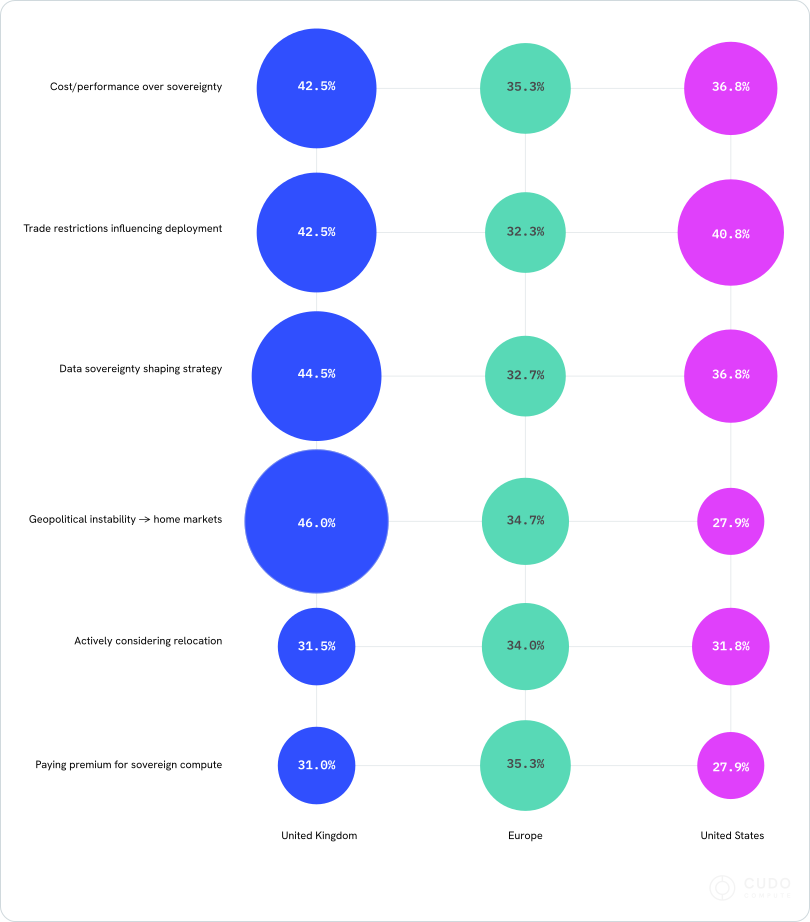
When asked what shapes their AI deployment decisions, respondents split almost evenly between cost and performance (37.8%) and data sovereignty (37.2%), but how regions balance the two diverges. Each market prioritises a different constraint based on power abundance, regulatory tolerance, and strategic posture.
The UK is the most sovereignty-conscious market, yet 42.5% still concede that cost trumps location. The US absorbs trade friction directly but refuses to retreat from international deployment. The EU is most willing to pay a premium for sovereign compute and most actively considers relocation.
Geopolitical factors influencing AI deployment by region
Strategic rivalry and supply chains
Geopolitical pressure no longer stops at where data centres are built. It now extends to where the chips inside them are manufactured. EU gigafactory tenders and UK government procurement increasingly evaluate the origin of the chip itself, not just where systems are assembled — applying the same scrutiny that excluded Huawei from telecommunications networks to AI infrastructure.
Trade restrictions and export controls already influence deployment decisions for 37.7% of respondents overall, rising to 40.8% in the US, where tariffs and chip export restrictions directly shape procurement options. AI-first firms experience this friction at 46%, 17 percentage points above the enterprise rate.
Adapting to today’s constraints
Software optimisation and algorithmic efficiency gains do not eliminate ecosystem-level power demand. They operate under the exact mechanics of the Jevons paradox, where increasing the efficiency of a resource simply drives up aggregate consumption of that resource.
Nearly one in five respondents have already scaled back AI workloads due to energy costs, and more than a fifth report that energy consumption accounts for over a third of their AI infrastructure budgets. Nearly a third actively evaluate alternative regions for deployment due to infrastructure considerations, and roughly a quarter would relocate entirely to secure renewable power. Only 3.3% do not expect power to influence where they locate workloads. The defining question now centres on whether organisations can adapt quickly enough to build within these tight physical constraints.
1/5
respondents have already scaled back AI workloads due to energy costs
1/5
report that energy consumption accounts for over a third of their AI infrastructure budgets
1/3
evaluate alternative regions for deployment due to infrastructure considerations
1/4
would relocate entirely to secure renewable power
New infrastructure patterns
Because operators cannot bypass physical limits through software alone, they must physically restructure their deployment models. The delivery methods that defined the first wave of AI infrastructure are already being replaced. ClusterPower CMO Toncu described the shift toward containerised, modular, and standardised designs, alongside industrialised scaling, as the primary methods for augmenting or replacing traditional construction to deliver capacity at AI speed. What was new six months ago may become obsolete within the next six months, he said.
Infrastructure is fracturing functionally to accommodate these physical realities. The physical split between training and inference workloads is accelerating this adaptation. Training focuses on power-rich, latency-agnostic locations, whereas inference distributes outward to end users. These two distinct workloads increasingly occupy entirely different facilities, geographies, and hardware architectures. Organisations designing a single facility type to handle both workloads are building for a market that has already moved past them.
- The next bottleneck is human
Once power, land, and cooling are resolved, the binding constraint becomes the workforce. “You can’t run a high-density AI facility with a traditional data centre ops team,” said Tim Dyce, CUDO’s Chief Technology Officer. “The skill set is fundamentally different — you need engineers who understand both the mechanical plant and the compute hardware, and there aren’t enough of them.”
Matt Hawkins, CEO of CUDO, described this as also a sovereignty issue. “If we create a sustainable AI infrastructure environment, you get people learning the engineering and data centre infrastructure skills needed to build and run this properly. That means jobs for thousands of people in the UK. Running a data centre takes serious resource. Running GPU clusters takes even more specialised expertise.” The talent pipeline is not a future problem. It compounds with every facility brought online.The next sequence of bottlenecks
As the market engineers solutions to current power and compute constraints, new bottlenecks will replace them. Talent is the least discussed and potentially the most binding. The industry needs engineers who understand facilities management at the density and complexity AI infrastructure demands, and there are not enough of them. Ark Datacentre’s Stirk’s response is to build the pipeline directly, “working with technical colleges and universities” to develop a dedicated workforce. Scaling construction capacity means scaling the human capacity to build and operate what is constructed.
The industry shift away from adiabatic cooling toward closed-loop systems is accelerating, but heat reuse is emerging as the more consequential design consideration. Facilities capable of exporting waste heat into district energy systems will face less community opposition and secure more favourable planning outcomes than those that simply dissipate it into the atmosphere.
Across the survey, 27.5% of respondents cite too much media hype relative to operational reality as a factor contributing to bubble concerns, a figure that rises to 33% in the UK. Community opposition actively delayed or blocked data centre builds in Dublin, Amsterdam, and multiple UK sites during the period this survey was fielded.
The opposition varies by geography. In metropolitan areas, Nilsson observed that the primary obstacle is “competition for grid capacity” driven by public perception that data centre expansion could “increase electricity prices for households and other businesses.” Rural expansion solves the spatial problem but introduces different resistance. Local pushback in secondary markets tends to “shift toward water usage and land use,” while maintaining similar concerns about grid capacity and its “impact on local industry and pricing.”
CloudAdvise’s Moss discussed when this must be addressed: “from day one. If community support isn’t there, build it into your timeline as a risk, because if you don’t have full buy-in from the municipality, it can derail delivery in ways that are hard to recover from.”
The organisations most exposed to this public sentiment are those building at the largest scale in the most visible locations — precisely the deployments the market most urgently needs. Constraints surrounding water, talent, operational complexity, and social consent are arriving on top of the land, power, cooling, compute, finance, and geopolitical limits that the market has not yet fully resolved. Scaling will continue only by confronting the physical, human, and political systems that AI infrastructure must navigate.
"There's more capital available now than there ever has been. This is an asset category that funders are starting to realise is a real thing. Despite the naysayers talking about bubbles, I haven't seen any slowdown in capital availability. Quite the contrary."
David Bell
The physical future of artificial intelligence
The artificial intelligence boom began as a software revolution, but scaling it is now a physical challenge. Organisations continue to model growth curves using obsolete cloud-era assumptions while the actual bottlenecks have shifted strictly to steel, concrete, and high-voltage transmission lines.
Survey data proves this constraint is already rewriting the infrastructure playbook. Three of the top five cost drivers identified by respondents are strictly power-related. 96% say geopolitical and infrastructure conditions are influencing where they deploy. Those waiting for software optimisation or hardware efficiency to rescue their deployment timelines will wait indefinitely.
96%
of organisations say geopolitical and infrastructure conditions are influencing where they deploy
What scaling AI now requires
The next phase of AI growth now requires an entirely new execution model. The successful operator must function simultaneously as an infrastructure developer, a utility negotiator, a community diplomat, and a structured finance expert. The compute hardware depreciates on a cycle that bears no resemblance to the facility it sits inside.
The pace of government policy consistently lags the hardware cycle, making traditional data centre timelines fundamentally incompatible with the speed of AI deployment. For Matt Hawkins, CEO of CUDO, this mismatch is already visible. “The AI growth zones were a good goal. The speed they’re running at is incredibly slow compared to the industry. By the time the first proposals get signed off, you’re two generations later on the GPUs. The idea is good, but the speed of delivery is significantly slower than the market needs.”
Training and inference diverge
Physical reality forces a market bifurcation over the next three years. Entities possessing massive capital will compete in the frontier training arena. These gigawatt-scale deployments demand dedicated off-grid generation and massive infrastructure commitments that exclude almost all traditional enterprise players.
The rest of the market must pivot toward distributed inference. This requires threading high-efficiency, memory-bound clusters into secondary markets where operators capture stranded municipal power and export waste heat to secure local public mandates.
“The market has no shortage of capital,” according to CUDO’s David Bell, “What it lacks is projects where land, power, and compute are genuinely aligned and contracted. Lenders underwrite what physically exists today, not what a pitch deck promises for next year.”
Beyond conventional geography
The severity of these constraints is pushing operators beyond conventional geography entirely. Subsea data centres now use the ocean as an infinite heat sink: China’s HiCloud has deployed commercial underwater facilities off Hainan Island since 2023, with plans to scale to 500 MW of wind-powered subsea capacity, while a June 2025 demonstration project connected servers directly to an offshore wind farm near Shanghai.
Meanwhile, SpaceX’s February 2026 acquisition of xAI was framed explicitly around orbital compute — Elon Musk wrote that ‘global electricity demand for AI simply cannot be met with terrestrial solutions’ and filed plans with the FCC for up to one million solar-powered data centre satellites. He is not alone: Jeff Bezos has predicted gigawatt-scale orbital data centres within twenty years, and NVIDIA-backed startup Starcloud orbited a satellite carrying an H100 GPU in late 2025.
These experiments demonstrate the lengths developers will go to escape grid bottlenecks. Still, neither subsea nor orbital facilities can currently support the scale and rapid hardware refresh cycles that AI demands. For now, the path forward runs through terrestrial infrastructure — specifically, pairing generation directly with consumption. As Hawkins puts it: ‘If you pair power generation with consumption, you’re not affecting everyone else on the grid. That’s good for the grid and good for the operator”.
Infrastructure first
The next era of artificial intelligence will be defined not by who has the most GPUs, but by who can power, cool, and connect them.
Tim Dyce, CUDO’s Chief Technology Officer, said the industry has the sequencing backwards: “Too many projects bring in the infrastructure team after the site is selected and the power is agreed. By that point, half the decisions that determine whether the facility can actually operate have already been made by people who don’t understand the mechanical consequences. Infrastructure has to be at the table from day one of site selection.”
The organisations that internalise this — treating zoning, power procurement, sovereign data policy, and cooling engineering as core competencies rather than downstream logistics — will be the ones that actually deliver AI at scale.
Appendix
Methodology
This report was produced by CUDO Compute, an engineering-led AI infrastructure provider operating at the intersection of land, power, finance and compute. Through a mix of owned capacity, partner-supplied clusters and managed services, CUDO is directly involved in how AI infrastructure is structured, deployed and operated at scale. The research draws on two complementary methods: a quantitative survey of decision-makers across the AI infrastructure lifecycle, and a series of structured interviews with infrastructure leaders responsible for deploying and operating AI workloads at scale.
The survey was conducted in partnership with Censuswide among a sample of 701 respondents across the UK, US and Europe, including France, Italy, Portugal, Romania, Spain and the Nordics: Denmark, Finland, Iceland, Norway and Sweden who have direct responsibility for AI workload and infrastructure decisions, budget input, vendor selection, or who are actively deploying AI workloads now or planning deployment, or who contribute input or recommendations for AI.
The data was collected between 12 and 25 February 2026. Censuswide is a member of the Market Research Society (MRS) and the British Polling Council (BPC), and a signatory of the Global Data Quality Pledge, adhering to the MRS Code of Conduct and ESOMAR principles.
In addition, CUDO conducted in-depth interviews with practitioners across fifteen organisations responsible for AI infrastructure decisions — from workload planning and capacity sizing to budget allocation and vendor evaluation. These interviews grounded the survey data in operational reality: how infrastructure is actually procured, provisioned, and run.
The team behind Land. Power. Compute.
Ashley Smith, Digital Marketing Manager, CUDO Compute
Emmanuel Ohiri, Content Writer, CUDO Compute
Kaitlin Argeaux, Event Manager, CUDO Compute
Kirthana Devaser, Product Marketing Manager, CUDO Compute
Madeleine Soden, Designer, CUDO Compute
Rebekah Pennington, Marketing Manager, CUDO Compute
Vince Howard, CMO, CUDO Compute
Contributors
Anushka Devaser, Technical Director of Sustainability Advisory, WSP
Allan Bosley, Director, Public Affairs, Ark Data Centres
Ben Pritchard, CEO, AVK
Ben Stirk, Head of Enterprise and AI, Ark Data Centres
Chris Milner, Partner, Holmes & Hills Solicitors
Chris Ward-Jones, COO and Co-founder, blocz
David Bell, Chief Financial Officer, CUDO Compute
Duncan Clubb, Senior Partner, Cambridge Management Consulting
Greg Ernst, Chief Revenue Officer, Intel
Greg Moss, Founder & CEO, CloudAdvise
Jack Halstead, Chief Commercial Officer, Novara Infrastructure
James Marks, Founder & CEO, Canopy Cloud
Kinda Sandy, Independent Energy Consultant
Luc Yu, Vice President, Supermicro
Marc Garner, Global President, Cloud & Service Providers, Schneider Electric
Matt Hawkins, CEO of CUDO
Michael Harman, Partner, Holmes & Hills Solicitors
Nick Henshaw, Finance Executive
Pete Hill, VP of Business Development, CUDO
Radu Toncu, CMO, ClusterPower
Richard Collar, VP Customer Solutions, Kao Data
Simon Muskett, Principal of AI & Quantum, Digital Realty
Sophie Bennett, Associate in Construction, Holmes & Hills Solicitors
Stefan Nilsson, CCO, Conapto
Tim Dyce, CTO, CUDO Compute
Wesley Anastase-Brookes, Commercial Sales and Marketing Director, Ark Data Centres
Endnotes
- Platformonomics, “Follow the CAPEX: Cloud Table Stakes 2024 Retrospective,” February 2025. https://platformonomics.com/2025/02/follow-the-capex-cloud-table-stakes-2024-retrospective/
- IO Fund, “Big Tech’s $405B Bet: Why AI Stocks Are Set Up for a Strong 2026,” November 2025. https://io-fund.com/ai-stocks/ai-platforms/big-techs-405b-bet
- IEEE ComSoc Technology Blog, “Hyperscaler capex > $600 bn in 2026,” December 2025. https://techblog.comsoc.org/2025/12/22/hyperscaler-capex-600-bn-in-2026-a-36-increase-over-2025-while-global-spending-on-cloud-infrastructure-services-skyrockets/
- Goldman Sachs, “Why AI Companies May Invest More than $500 Billion in 2026,” December 2025. https://www.goldmansachs.com/insights/articles/why-ai-companies-may-invest-more-than-500-billion-in-2026
- Bloomberg, “Data Centers in NVIDIA’s Hometown Stand Empty Awaiting Power,” November 2025. https://www.bloomberg.com/news/articles/2025-11-10/data-centers-in-nvidia-s-hometown-stand-empty-awaiting-power
- International Energy Agency, “Energy and AI: Executive Summary,” April 2025. https://www.iea.org/reports/energy-and-ai/executive-summary
- Epoch AI, “How Much Energy Does ChatGPT Use?,” February 2025. https://epoch.ai/gradient-updates/how-much-energy-does-chatgpt-use
- Newsweek/EPRI and Epoch AI, “Training AI Models Could Eat Up 4 Gigawatts of Power by 2030,” August 2025. https://www.newsweek.com/training-ai-models-could-eat-4-gigawatts-power-2030-report-warns-2112002
- McKinsey, “The Next Big Shifts in AI Workloads and Hyperscaler Strategies,” December 2025. https://www.mckinsey.com/industries/technology-media-and-telecommunications/our-insights/the-next-big-shifts-in-ai-workloads-and-hyperscaler-strategies
- Lawrence Berkeley National Laboratory, 2025. https://emp.lbl.gov/queues
- S&P Global, “Global AI Power Demand: Challenges and Opportunities,” December 2025. https://www.spglobal.com/en/research-insights/special-reports/look-forward/data-center-frontiers/global-ai-power-demand-challenges-opportunities
- AlgorithmWatch, “What Ireland’s Data Center Crisis Means for the EU’s AI Sovereignty Plans,” December 2025. Data centres accounted for a 22% share of total Irish national electricity consumption in 2024. The Commission for Regulation of Utilities imposed an effective moratorium on new data centre grid connections in Dublin. https://algorithmwatch.org/en/ireland-data-center-crisis-eu-sovereignty/
- Data Centre Dynamics, “The ongoing impact of Amsterdam’s data center moratorium,” August 2024. The total number of data centres in the Netherlands was lower in 2023 (187) than in 2019 (189), with the number of colocation companies falling from 111 to 95 over the same period. https://www.datacenterdynamics.com/en/analysis/the-ongoing-impact-of-amsterdams-data-center-moratorium/
- King & Wood Mallesons, “Singapore Launches 200MW Data Centre Call for Application (DC-CFA2),” December 2025. Singapore maintained a de facto moratorium on new large-scale data centre approvals from 2019 to 2022. The moratorium-constrained supply created one of the tightest markets globally, with vacancy rates below 2%. https://www.kwm.com/global/en/insights/latest-thinking/singapore-launches-200mw-data-centre-call-for-application-dc-cfa2.html
- White & Case, “Data centres and energy consumption: evolving EU regulatory landscape and outlook for 2026,” 2025. The European Commission will put forward a Data Centre Energy Efficiency Package in Q1 2026, aiming to achieve carbon-neutral data centres by 2030. Mandatory sustainability reporting under the Energy Efficiency Directive applies to facilities with installed IT power demand of at least 500 kW. https://www.whitecase.com/insight-alert/data-centres-and-energy-consumption-evolving-eu-regulatory-landscape-and-outlook-2026
- Ember, “Grids for data centres: ambitious grid planning can win Europe’s AI race,” June 2025. It takes an average of 7-10 years to connect a data centre to the grid in legacy hubs, with countries experiencing lower grid congestion expected to see double the data centre growth. https://ember-energy.org/app/uploads/2025/06/Grids-for-data-centres-in-Europe.pdf
- techUK / Pinsent Masons, “UK data centres approved by parliament as nationally significant infrastructure projects,” November-December 2025. The Infrastructure Planning (Business or Commercial Projects) (Amendment) Regulations were approved by the House of Lords in November 2025. Data centres were designated as Critical National Infrastructure in September 2024. https://www.pinsentmasons.com/out-law/news/uk-data-centres-nationally-significant
- House of Commons Library, “Data centres: planning policy, sustainability, and resilience,” March 2026. The UK had approximately 1.6 GW of data centre capacity in 2024, with preliminary analysis for the government finding capacity could rise to between 3.3 GW and 6.3 GW by 2030. https://commonslibrary.parliament.uk/research-briefings/cbp-10315/